
Stonewall County Busted Booking Records
A trip to a Texas jail starts a paper trail. Detention staff open a booking file on arrival. Inside it: a name, the booking date, the charge listed at intake, and any bond amount. Later entries may note a release or a transfer. A mugshot can sit in the file too, if one was taken and kept. Still, this is not a warrant and not a full criminal-history report.
Here is the catch for Stonewall County. The sheriff's office runs the county jail. Its official sources publish no searchable roster and no public photo display. So a missing web result proves nothing at all. A person arrested there could have been released, moved to another agency, or never lodged at the county jail. Ask the custodian which office holds the record before you decide it does not exist.
Important: The charge written down at booking is only the starting label, and the court file may later show a plea, a dismissal, a reduction, or another result entirely.
Stonewall County Booking Record Fields
Stonewall County publishes no official booking roster online. So think of what follows as a request checklist, not a description of a live database. A narrow, specific request helps the sheriff locate the right file fast. Include the booking number if you have it. If you don't, give a full name, a rough date, and the arresting agency instead.
| Field | Why it matters |
|---|---|
| Full name and aliases | Helps distinguish people with similar names when matching a jail and court file. |
| Booking number and intake date | Identifies a particular jail transaction and separates booking time from arrest or release time. |
| Arresting agency | Shows whether the sheriff, Aspermont Police, Texas DPS, or another agency may hold the original arrest report. |
| Charges as booked | States the intake charge. It is not the final court disposition. |
| Bond, release, or transfer | Explains custody movement when the field exists. A vanished roster entry alone cannot do that. |
| Photo and retention status | Lets the custodian answer whether an existing booking image can be inspected or copied after review. |
| Court or cause number | Provides the bridge from the booking packet to the clerk or district court record. |
When you write, ask the sheriff to say which fields exist, which can be released, and which must be redacted. Texas treats some material differently. Age, certain personal details, victim information, and anything involving juveniles may be withheld or trimmed. "Basic information" under state law does not entitle you to every page of the packet in its original form.
- Booking
- Jail intake after an arrest, often including identification and custody information.
- Bond
- A financial or personal-release condition set during the court process.
- Disposition
- The court’s result, such as dismissal, acquittal, plea, conviction, or another recorded outcome.
- Expunction
- A court-ordered process that can require eligible records to be deleted or made unavailable under Texas law.
Request Stonewall County Busted Records
Start any records request with the Stonewall County Sheriff's Office. The published contact details are P.O. Box 388, Aspermont, TX 79502, phone 940-989-3333, and jailadmin@stonewallcountytx.org. There is no verified separate records line, no online request form, and no posted booking-photo fee schedule. Two quick questions save trouble. Confirm the jail-admin email accepts Texas Public Information Act requests, and ask for a cost estimate before any charges pile up.
- Identify the person, approximate booking date, arresting agency, and booking number if available.
- Ask for the existing booking record and, separately, any existing booking photograph, plus release or transfer information and the applicable retention schedule.
- Request electronic delivery if available, a written cost estimate, and the legal basis for each withheld or redacted item.
- If Stonewall does not hold the record, preserve that response and send the focused request to the named police, jail, state, or federal custodian.
The Texas Attorney General's request guidance makes one point clear: a public-information request reaches records that already exist, not records someone creates for you. Texas Government Code §552.108(c) keeps basic arrest information open even when other law-enforcement material may be withheld. A photograph still takes a case-by-case decision, though. Ask for it plainly rather than assuming it must be posted publicly.
Note: Stonewall County has posted no jail-photo fee schedule, so a targeted request with an advance estimate beats borrowing fees from some other county office.
You can view the sheriff's contact page on the official county source.
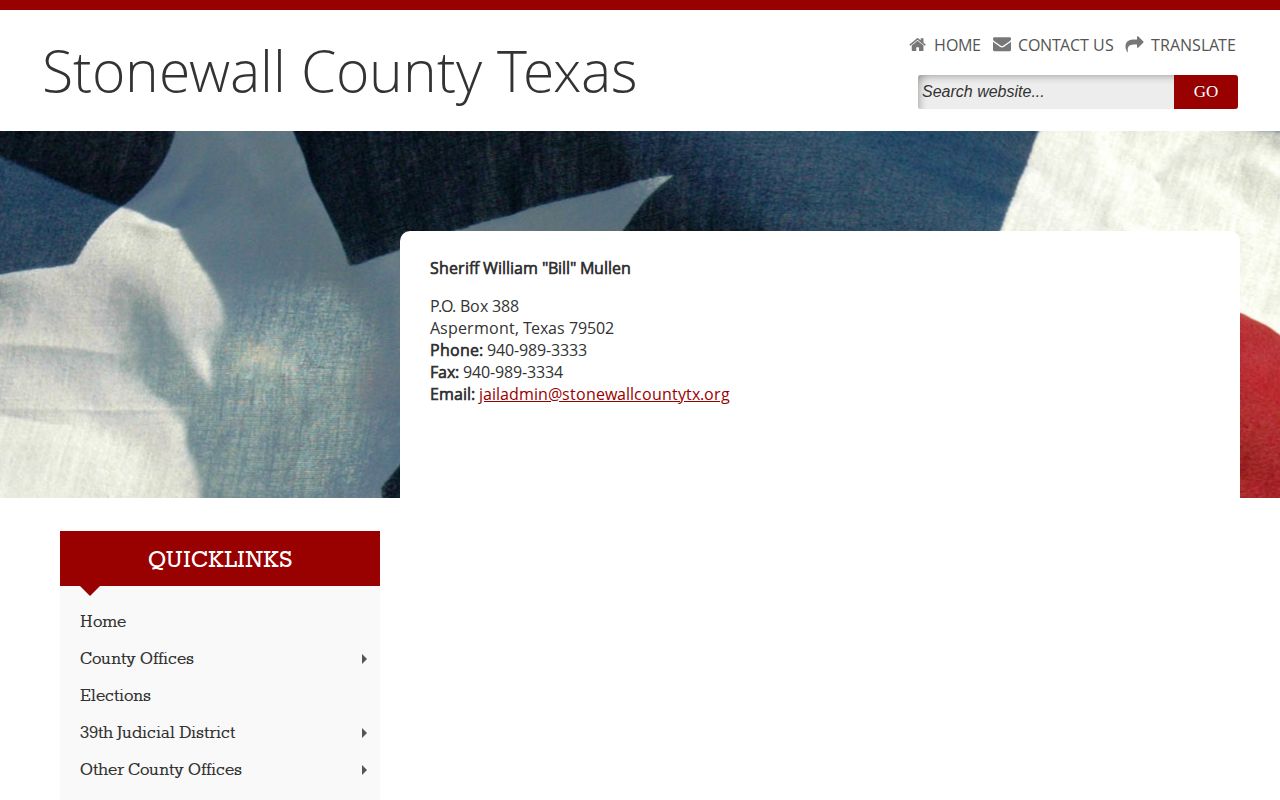
That page supports a contact-first approach. It does not show that Stonewall County runs a public photo gallery or a live jail roster.
Texas Law and Busted Photo Requests
Texas Business & Commerce Code Chapter 109 is the state's central law on publishing criminal records. It covers accuracy duties, dispute contacts, free correction or removal of wrong information in certain cases, confidential juvenile material, and records touched by expunction or nondisclosure. It does not hand anyone a blanket right to scrub an accurate, current booking image. Definitions and exceptions carry real weight here. Name the exact record and your legal basis.
Fixing an error starts with the government custodian, not a website. For expunction or nondisclosure questions, get the court record or order and follow the current Texas Code of Criminal Procedure Chapter 55A process. The two remedies are not twins. Expunction can order deletion or redaction of eligible material. Nondisclosure seals qualifying records from public view but leaves some officials with access. Eligibility always depends on the facts.
Once a source corrects or removes material, the search engine's official outdated-content process can refresh the stale search result. Keep copies of the correction response and any court paperwork. And be wary of paid promises to hide a record. Nothing replaces the source, the statute, or a court order.
Juvenile and sealed records: Handle a juvenile or confidential record as its own animal, not an ordinary adult booking request, and ask the custodian or a qualified Texas attorney about the controlling order and current access limits.
Find Stonewall County Busted Mugshots
No verified online booking portal exists for Stonewall County. That makes the order of your search matter more than the tools. Start with the sheriff for any current county-jail question, and ask whether in-person or non-indexed access exists. Was the arrest in Aspermont? Then ask the city whether it kept the arrest record or passed the person along. Court sources come next for a case outcome. Reach for state or federal locators only once custody has moved beyond the county system.
- Contact the sheriff for current-custody access, a booking date, and a booking number.
- Use a targeted Texas public-information request if there is no public view or if a historical photo or packet is needed.
- Check the arresting agency when the sheriff says another agency created or retained the record.
- Follow a known cause number through the clerk, 39th District Court, or re:SearchTX for disposition.
- Use TDCJ, BOP, ICE, or U.S. Marshals routes only for their separate state, federal, or immigration custody roles.
Each channel answers a different custody situation. A person just booked is likely still in county hands. Someone released on bond may vanish from every current-custody view even though the record survives. And a person sent to Texas prison can show up in a state locator long after the Stonewall booking file stops being the active location record.
| Source | Custody or record state | Photo status and access |
|---|---|---|
| Stonewall Sheriff | Best verified local contact for current county custody or an existing booking record. | No public roster or photo display was verified. Ask for the current policy. |
| Aspermont Police records | Municipal arrest report or transfer question. | No city blotter or photo feed was verified; request an existing record through the city. |
| TDCJ | Later Texas state custody after a state-prison or state-jail sentence. | Public locator does not advertise a booking-photo field. |
| Clerk and court routes | Charges after filing, hearings, and disposition. | Court record, not a county booking-photo source. |
| Mugshots.com Stonewall page | Unofficial secondary lead only. | May be incomplete or stale. Verify each apparent entry with the sheriff and court. |
Stonewall County Busted Roster Access
Stonewall County has no public jail roster that can be verified. The sheriff's site offers nothing to search. No inmate lookup, no bookings feed, no form. It also skips details like update schedules or how long a name stays listed. So the honest takeaway is simple: a public roster could not be confirmed. That is not the same as saying the jail sits empty.
If a roster ever surfaces, a few questions will tell you its worth. Does it search by name, booking number, or date? Can it sort current detainees from people already out? Look for bond amounts, court dates, and any booking photo too. And get the stated refresh time rather than guessing at delays from one visit.
One more wrinkle comes from the Texas Commission on Jail Standards. Its filings show Stonewall's past compliance issues and a shift toward full-service jail operation. Those facts explain why confirming custody status matters here. They do not mean an online roster exists, though, or that one is required.
When Stonewall Busted Records Appear
Don't expect same-day bookings online. Stonewall County publishes no 24-hour, 48-hour, or 72-hour booking view. No weekly or rolling arrest log either. The county homepage, sheriff page, and Aspermont police page all lack a stated posting schedule. An arrest this morning may never show up on the web. And a missing online entry proves nothing either way.
When time matters, go straight to the source. Ask the sheriff's office whether intake is complete and whether the person was actually accepted into Stonewall County Jail. Ask the arresting agency too. A person can sit in city, state, or federal custody instead. A phone answer helps you find the route. A dated written request works better when you need an actual record.
Note: Frame any records request around a name, date, agency, and record type rather than asking broadly for every recent image.
Stonewall Booking Records Meet Court Files
A booking record is only the first step in the trail. Court files come next. Stonewall County keeps them with County Clerk Holly McLaury. Her office sits at 128 Town Square Lane, Drawer P, Aspermont, TX 79502. Reach her at 940-989-2272 or holly.mclaury@stonewallcountytx.org. Hours run Monday through Thursday, 8:00 a.m. to 4:30 p.m., and Friday, 8:00 a.m. to noon, with a lunch closure from noon to 1:00. Keep in mind those are clerk hours, not jail hours.
For cause numbers, dockets, and filings, start with the county records search and the 39th District Court. That court sits mainly in Haskell. It still serves Stonewall, though. So a Stonewall case can live in the district system without appearing on a county docket page. The statewide re:SearchTX portal adds another option, but it is not a complete index of every Texas trial-court record.
Stonewall Arrests Beyond County Custody
Custody doesn't always mean county jail. The TDCJ Offender Search covers people committed to Texas state custody, usually after a sentence to state prison or state jail. Search by TDCJ or SID number first, and fall back on name plus other identifiers carefully. The tool can show a facility location, offenses, and projected release. It won't tell you who was booked in Stonewall yesterday, and it has no public booking-photo field.
Federal systems are narrower still. The Federal Bureau of Prisons locator handles federal custody, while the ICE Online Detainee Locator covers immigration detention. U.S. Marshals records go through that agency's FOIA process. None of these replaces the sheriff's answer on a current Stonewall booking.
Stonewall Booking Alerts and Apps
There is no sheriff's app for Stonewall jail information. No official booking account, no inmate-lookup app, no verified photo feed. Treat that as the current situation, not a promise about what the county may add later. Before trusting some generic app store result, ask the sheriff whether an official portal or vendor tool has been adopted.
Aspermont does offer a general municipal news and alerts subscription. The city and police pages do not describe it as a channel for custody, warrant, arrest, or booking-photo information. TDCJ's IVSS and Texas VINE provide notifications where participation applies. Neither publishes mugshots. And Stonewall County's participation in a VINE feed has not been confirmed.
Aspermont Busted Mugshots and Records
Aspermont is the only incorporated town in Stonewall County. Its Police Department page is purely informational. No daily bulletin, arrest log, roster, or booking-photo feed appears there. No police records number is published either. City hall sits at 411 S Broadway St, Aspermont, TX 79502. The general city line, 940-989-3585, is not confirmed as a police non-emergency number.
To request a police report, use the city's open-records page or its contact form, and ask which office actually holds the record. An Aspermont arrest may end up in county detention. But no official city transfer rule is published. Confirm the arresting agency and the booking destination case by case. The Aspermont Busted Mugshots page walks through these same limits for the local lookup path.
Stonewall County Old Booking Context
Older Stonewall County arrest news lives in a different place than current rosters. The Portal to Texas History collection holds digitized Aspermont Star and Stonewall County Courier material, supplied through the Stonewall County Library. Public notices and old news items appear there. It is not a booking feed, though. Nobody in custody today will show up in those pages. The archive is no stand-in for an official record.
The distinction matters when you are chasing a past arrest. A newspaper story tells you what got reported at the time. A court docket or a clerk's copy tells you what happened afterward, which is often the real answer. Want an old booking photo or packet? The sheriff's retention response can say whether one still exists. Match the source to the question instead of treating archival clippings like a live roster.
Stonewall County Jail Record Changes
A jail's past is not a roster result. Texas Commission on Jail Standards records show inspection findings at Stonewall County Jail in 2022. Corrective work followed, and the facility returned to full service during 2024. The state's current non-compliant list leaves Stonewall off it. That is context for a small county system, nothing more. It says nothing about capacity, head count, whether a public booking site exists, or whether any photo was released.
That history is exactly why each access method should be confirmed with the sheriff. A search-engine link can go stale. A vendor page may hide behind a login. Directories sometimes repeat details no one verified. If the office offers a current roster or an in-person viewing option, write down the web address, the search fields it supports, and whether it covers current custody, releases, or both. A fresh word from the custodian beats guessing from old operations.
Stonewall County Busted Photo Policy
Stonewall County publishes no sheriff policy on booking photos. That silence leaves room for two possibilities worth checking by phone. The sheriff may keep an intake photo on file without displaying it anywhere, or a future public listing could carry only a cropped, time-limited image. Neither exists today, so treat both as questions rather than assumptions. When you call, ask four things: whether a photo was taken at booking, whether it sits in the booking packet, whether it survives after release, and whether a copy can be inspected.
Texas public-information law frames that conversation. It cannot conjure a webpage that is not there, and a missing page proves nothing either way. If the answer comes back no, press for specifics. Maybe no image exists at all, another agency holds it, part is redacted, or a statute blocks release. Get the stated reason in writing. A paper trail matters if the request must move to a city department, a state custodian, a court, or a later correction.
Stonewall County Court Search Limits
No single portal holds every Stonewall County criminal case. Think of the search as three overlapping tools. Local clerk links handle some filings, and the county's district court page covers its own matters. Meanwhile, re:SearchTX reaches a different slice of the state's dockets. Match names carefully, because a party search can pull up several people who share a name. A booking number will not serve as a court cause number. Start with an exact name and date, then ask the Clerk or District Clerk which court keeps the case and whether the document is online or requires a copy request.
The Texas court FAQ notes that the Office of Court Administration keeps no individual case files. That is exactly why a docket search should end with a call to the responsible clerk. It also helps to keep the roles straight. The sheriff answers who is in jail right now. The arresting agency answers its own report. The court file answers what became of the charge. Mixing those jobs up leads searchers down the wrong path fast.
Stonewall Busted Alerts Are Unverified
Booking alerts look like a shortcut, but they rest on two things: a named system and a custodian who participates. In Stonewall County, neither is confirmed. No sheriff app and no county-jail VINE enrollment could be verified. Texas VINE and TDCJ IVSS serve a narrow purpose anyway. They are notification channels, not photo archives, and an alert about a custody event says nothing about a public booking image.
So route each question to its proper source. Worried about release or transfer? Ask the sheriff which notification program, if any, covers Stonewall County and who may sign up. Looking for someone in state custody? Use the matching TDCJ location record. Need a court outcome? Call the clerk or the court itself. Every one of these sources has a small, defined job. None of them adds up to a roster of everyone recently arrested in Stonewall County, and stretching them that way only wastes time.
Stonewall Booking Records After Court Orders
Chapter 55A of the Texas Code lays out several paths to expunction. Acquittal, pardon, mistaken identity, dismissal, and certain releases without conviction each carry their own route, with waiting periods and limits that turn on the facts of the case. When a court grants the order, it can direct government offices and named private entities to delete or redact a booking record. Statutory exceptions still apply. And the label on the original charge tells you nothing about eligibility on its own.
Nondisclosure works differently. It seals qualifying information from the public while leaving specified official access in place, which makes it a narrower tool than expunction. Anyone seeking either remedy should obtain a certified or file-stamped copy of the order and keep the court and case details handy. Each record holder then needs to be asked directly how it will apply the order. If an official record gets corrected or removed, refreshing the search result is a separate request to the search provider. A Texas attorney or the appropriate court clerk can advise on eligibility and drafting.